
Following GPU writes across chiplets and verifying reset completion
Kaushik Velapareddy
Abstract
When a GPU kernel finishes, a dependent operation needs to see the result that the programming model promises. That guarantee depends on more than the matrix engines. Compute dies, caches, the fabric, and the memory subsystem all play a part. This article follows one matrix result through a chiplet-based GPU, then uses an AMD-confirmed recovery issue to motivate a directed verification scenario for a reset with writes in flight.
1 A Recovery Failure in the Field
In September 2024, AMD documented an MI300X issue in which a GPU recovery reset triggered by an uncorrectable error could fail to complete. An affected system could require a reboot, and error logging could fail during the same incident. AMD marked the issue fixed in ROCm 6.2.2. [1]
That report raises a practical verification question. If recovery interrupts a workload, how does software distinguish a failed job from a device that is safe to use again? To see why those events can occur at different times, start with the writes a GPU kernel leaves behind.
2 Where a Matrix Result Goes
Take one linear layer in a transformer. Its matrix multiply reads activations and weights and produces output activations for later work. The host queues a kernel for execution. The GPU schedules work-groups on its compute units, where an optimized kernel can load portions of the input matrices, reuse those values in registers or local shared memory, and accumulate elements of an output tile. The final stores place that tile in a device buffer. The resulting cache and memory triadic depend on the Kernal implementation and access pattern.[2]
AMD’s MI300X puts this data path in a multi-die package. It integrates eight GPU compute dies, four I/O dies, and eight HBM3 stacks totaling 192 GB. AMD documents Infinity Fabric as the interconnect. The physical split puts part of the route between compute and HBM across die boundaries. [3, 4]
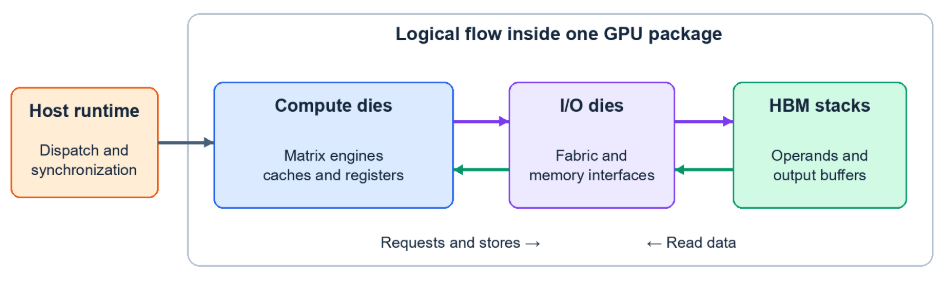
Figure 1. Logical data flow for a GPU kernel. The drawing simplifies the package topology and omits cache hits and local operand reuse. [2–4]
A dependent kernel can consume the result once the relevant synchronization guarantees visibility. Those guarantees depend on the consumer and its scope. For example, a dependency within a GPU stream and a host waiting to read a copied result have different paths. A store accepted by the fabric is an earlier event than software learning it may safely use the result. [2]
From one package to a rack
A chiplet package sits inside a larger system. A server can contain several GPU accelerators, and a rack can connect many GPUs into a communication domain. NVIDIA’s GB200 NVL72, for example, connects 72 Blackwell GPUs and 36 Grace CPUs in one rack. Larger installations connect racks through a cluster network. These links serve different scopes from the die-to-die fabric inside a GPU package. [5]
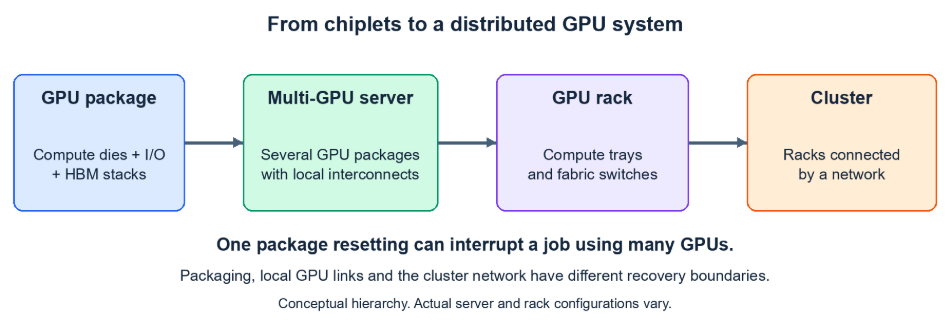
Figure 2. Conceptual system hierarchy from one GPU package to racks and a cluster. Interconnects and recovery boundaries depend on the system architecture.
At this scale, the consequences of a local interruption become system-wide. When several GPUs participate in a distributed operation, one unavailable participant can keep its peers waiting until the communication runtime reports an error and initiates recovery. The affected job may need to restart from a checkpoint, depending on its recovery support. A package-level drain acknowledgment establishes a local boundary. The driver and distributed runtime also need a defined way to retire or fail work involving that device. The example below concentrates on that local boundary.
3 Reset While the Final Writes Are in Flight
Consider a hypothetical accelerator that can reset a compute die while its fabric and memory subsystem remain active. A kernel has issued its final stores, but several writes are still outstanding. This example explores the recovery contract for such a design. AMD’s public report establishes a GPU recovery failure and provides no die-level reset sequence or root cause. [1]
In an illustrative recovery policy, the design stops new requests, drains accepted writes, and reports the interrupted job as failed. Software discards the output and holds the allocation until old traffic can no longer modify it. This requires the drain machinery and response paths to remain operational through the reset sequence.
A late response also matters when transaction IDs are reused. If a new request receives an ID that belonged to an interrupted request, an old response must not complete the new one. Verification can delay that response across reset and submit new work at the earliest permitted point. ID reuse needs a defined retirement rule or a supported generation tag.
Flushing traffic before a coordinated reset
A coordinated SoC reset can begin with a register write that sends a flush across the chip-to-chip path. When the receiving block sees it, the block stops accepting new requests on that path and allows previously accepted work to complete. Reset waits for the drain acknowledgment. Here, flush means quiescing and draining transaction traffic. Any required cache writeback or invalidation needs its own defined sequence.

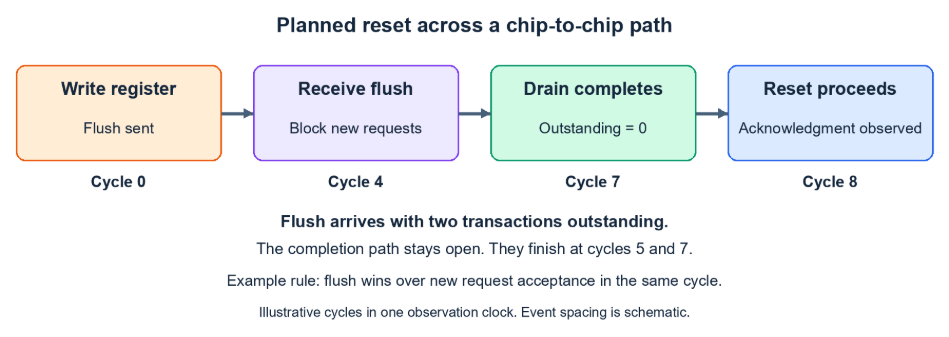
Figure 3. Illustrative timing for a design that gives flush priority over same-cycle packet intake. Cycle numbers are selected for the example. Event spacing is schematic.
Figure 3 assumes a shared observation clock and a receiver that gives flush priority over same-cycle requests. Two transactions are outstanding when the flush arrives at cycle 4. They complete at cycles 5 and 7. The receiver keeps the completion path open and blocks new requests. The controller observes drain completion and proceeds at cycle 8. The cycle numbers are illustrative. A design with independent die clocks also needs an acknowledgment that safely crosses back to the reset controller.
4 What to Check Before Signoff
Use the register-driven sequence for planned reset and inject an interruption independently to exercise fault recovery. Track acceptance and completion by transaction ID. For stores, observe when they can still modify the destination and compare that point with the driver’s buffer release event.
| Stimulus | Expected behavior | Failure symptom |
| New request arrives with the flush | The receiver follows the specified priority. Every request it accepts counts toward the drain. | A request slips through the cutoff or is missing from the outstanding count. |
| Delay an accepted completion during a planned reset | Existing work keeps completing. Reset waits until the final outstanding transaction retires. | Reset advances early or drain stalls because the completion path is blocked. |
| Flush an empty receiver | Drain completes without waiting for transaction traffic. | Reset waits for a completion that will never arrive. |
| Interrupt a job before acceptance, after acceptance, or after the store becomes visible | Under the example recovery policy, discard unaccepted work, drain accepted work, and report job failure. Hold the buffer until old traffic can no longer modify it. | A delayed store changes the next owner’s sentinel pattern, or software sees an incorrect success. |
| Delay an old response and submit a new request at the earliest legal point | A response from before reset cannot satisfy a new request. | A new request completes when an old response arrives. |
In RTL, check that the outstanding count reaches zero before planned reset advances and that a blocked receiver still accepts completions. Exercise an empty queue, a full queue, and a final completion arriving with the flush. In emulation, run the driver’s abort and buffer release path, including recovery timeout. Retain enough diagnostics to identify the outstanding operation if recovery stalls. [1]
Conclusion
The stream of work that starts with a matrix multiply ends in a guarantee to software. In a chiplet GPU, the guarantees for a completed job and an interrupted one depend on logic spread across multiple dies. A useful signoff test follows one result across those boundaries and asks software’s two questions directly. When may I read it, and when may I reuse the memory?
References
[1] AMD ROCm issue 3766, MI300X recovery failure on uncorrectable errors
[2] AMD ROCm documentation, Introduction to the HIP programming model
[3] AMD ROCm documentation, AMD Instinct MI300 Series microarchitecture
[4] AMD Instinct MI300X accelerator specifications
[5] NVIDIA GB200 NVL72 product overview. https://www.nvidia.com/en-us/data-center/gb200-nvl72/
About the author
Kaushik Velapareddy is a Principal Design and Verification Engineer with more than 18 years of experience. His work includes RDMA over Converged Ethernet and SoC verification, including reset sequencing and outstanding transactions. His published work covers Universal Verification Methodology, functional coverage closure, and FPGA-based acceleration of RTL simulation. He writes about verification challenges in complex semiconductor systems.