Evolving Requirements for Liquid Cooling Plates
In recent years, liquid cooling plate designs have become more complex. Smaller channels, higher power densities, tighter dimensional tolerances, and increasing production volumes are creating new manufacturing challenges that extend far beyond thermal design.
Why the Joining Process Matters
For liquid cooling plates, the joining process is not simply a manufacturing step. It directly influences leak integrity, pressure resistance, internal flow distribution, flatness, dimensional stability, and long-term reliability. In a microchannel liquid cooling plate containing numerous internal flow passages, even a localized joining defect can restrict coolant flow, create local hot spots, or eventually lead to leakage.
Vacuum brazing, controlled-atmosphere brazing, and diffusion bonding are three of the commonly used furnace-based joining technologies in liquid cooling plate manufacturing. However, selecting the appropriate process involves much more than comparing joining temperatures.
Choosing a Joining Process for Liquid Cooling Plates
| Factor | Vacuum Brazing | Controlled-Atmosphere Brazing | Diffusion Bonding |
| Joining mechanism | Filler metal melts and flows under vacuum | Filler metal melts and flows in a protective atmosphere | Solid-state bonding through heat, pressure, and atomic diffusion |
| Production characteristics | Primarily batch; lower throughput | Well suited to continuous, higher-volume production | Primarily batch; longer cycles and higher process cost |
| Suitable designs | Complex assemblies, enclosed channels, multiple joints | Repeatable assemblies suited to continuous conveyor processing | Stacked or planar multilayer structures where filler metal is undesirable |
| Main process challenge | Cleanliness, filler control, loaded temperature uniformity, vacuum integrity | Oxygen/moisture control, atmosphere distribution, filler wetting | Surface flatness, temperature/pressure uniformity, tooling, deformation |
| Main equipment focus | Vacuum system, temperature uniformity, partial pressure, cooling | Multi-zone heating, atmosphere distribution, transport, cooling, gas safety | Heating + pressure system, platen alignment, tooling, vacuum/atmosphere control |
| Main reason to select | Clean, high-integrity joining of complex assemblies | Economical, repeatable high-volume production | Filler-free joining with high joint integrity |
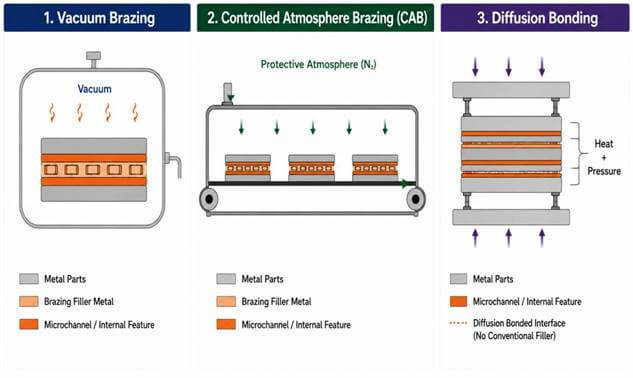
Vacuum Brazing: Prioritizing Joint Quality Over Production Throughput
Vacuum brazing is often selected for liquid cooling plates with complex geometries, enclosed microchannels, multiple joining interfaces, and high-performance thermal-management requirements.
Unlike continuous brazing processes, vacuum brazing is typically a batch operation. As a result, it is often preferred when joint quality, process cleanliness, and dimensional stability are more important than maximum production throughput.
A major advantage of vacuum brazing is the ability to produce dense, clean joints with low porosity while joining multiple interfaces within a complex assembly in a single furnace cycle. For liquid cooling plates with enclosed channels or numerous internal joints, this makes vacuum brazing particularly attractive for high-performance applications and lower-volume production.
The high-vacuum environment is an important part of achieving this process quality. By minimizing oxygen exposure during heating, vacuum processing limits oxidation and can improve filler-metal wetting and flow. Combined with appropriate joint design, fixturing, temperature uniformity, and thermal-cycle control, the process can achieve low distortion and consistent joint formation.
Material Behavior Under Vacuum. Certain alloying elements, including magnesium, chromium, copper, and manganese, may vaporize under high-vacuum conditions at brazing temperatures. Depending on the material system, partial-pressure brazing may be used to reduce material evaporation and maintain a more stable brazing environment.
Vapor Management. Residual oils, binders, and other organic materials may generate vapors during heating.
Loaded Temperature Uniformity. Evaluating temperature uniformity under representative production loading is often far more valuable than relying exclusively on empty-furnace specifications.
Controlled-Atmosphere Brazing: When Production Throughput Becomes the Primary Driver
Controlled-atmosphere brazing (CAB) is particularly attractive for standardized liquid cooling plate designs and medium- to high-volume manufacturing.
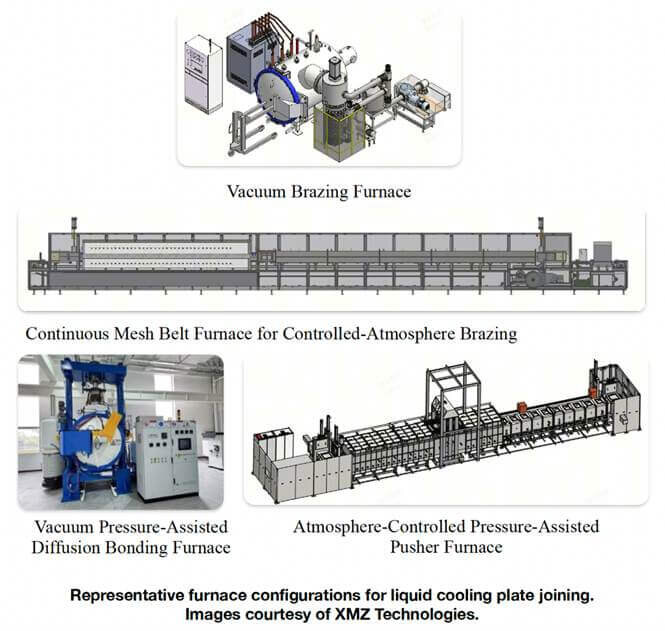
Unlike vacuum brazing, CAB typically uses a continuous mesh belt furnace that transports components through multiple heating and cooling zones, enabling significantly higher throughput and lower operating costs.
One of the major process challenges in CAB is maintaining a stable and controlled furnace atmosphere. Key variables include oxygen concentration, dew point, gas purity, furnace pressure, gas flow distribution, and belt speed.
In hydrogen-assisted brazing systems, atmosphere control also extends beyond metallurgical considerations. Oxygen monitoring, hydrogen management, purge sequences, safety interlocks, and exhaust treatment become important elements of furnace design. Maintaining a stable, zone-specific process atmosphere is critical because variations in gas composition, oxygen level, and gas distribution across different furnace zones can directly influence filler-metal wetting, joint formation, and overall product consistency.

In one high-temperature belt-furnace configuration developed for reducing-atmosphere brazing, oxygen levels below 10 ppm and dew points down to approximately -60°C were used together with high-purity nitrogen and hydrogen and cross-belt temperature uniformity of approximately ±1–2°C.
Diffusion Bonding: Eliminating Filler-Metal Intrusion into Microchannels
Diffusion bonding differs fundamentally from conventional brazing because no filler metal is introduced into the joint. Instead, carefully prepared surfaces are joined through the combined effects of elevated temperature, applied pressure, and atomic diffusion.
The process is particularly attractive for stacked structures, etched microchannels, multilayer assemblies, high-density heat exchangers, and other designs that cannot tolerate filler-metal residue.
One of the biggest advantages of diffusion bonding is the elimination of the filler layer itself. Without molten filler metal, diffusion bonding can produce dense, low-porosity joints with mechanical properties approaching those of the parent material. In liquid cooling plate manufacturing, eliminating filler metal removes the risk of filler-metal intrusion into fine internal channels, which can be especially important in high-density cooling structures.
However, diffusion bonding introduces a different set of engineering challenges. Many engineers focus primarily on bonding force, but in practice pressure distribution is often more important than nominal pressure alone. Large-area liquid cooling plates require uniform pressure distribution, flat bonding surfaces, accurate platen alignment, stable tooling, and controlled thermal expansion. Uneven loading can easily cause local deformation, particularly in large or thin-walled structures.
For large bonding areas, pressure-system design may also require structural analysis of the platen and load path to ensure that the applied pressure remains uniform at temperature rather than being distorted by thermal or mechanical deflection.
Channel geometry must also be considered during process development. Thin channel walls may collapse under pressure, while unsupported regions may deform during high-temperature processing. Successful diffusion bonding therefore requires simultaneous optimization of furnace temperature, pressure transmission, tooling design, and component geometry.
Rather than being treated solely as a joining process, diffusion bonding should be evaluated as a combined thermal and mechanical manufacturing process.
Four Questions Engineers Should Ask Before Selecting a Joining Process
- Can the design tolerate filler metal?
If filler metal can enter fine internal channels or leave unacceptable residue, diffusion bonding may be preferred. If filler metal is acceptable, vacuum brazing and CAB can often provide more practical or economical manufacturing routes, depending on production requirements.
- What production volume is required?
Vacuum brazing is typically batch-based, while controlled-atmosphere brazing is well suited to continuous production. Production volume can therefore be a major process-selection factor alongside joint-quality requirements.
- How sensitive is the design to pressure and deformation?
Diffusion bonding eliminates molten filler-metal flow but introduces mechanical loading. Thin channel walls, unsupported regions, and large bonding areas can make pressure distribution and tooling design critical.
- How demanding is atmosphere control?
Vacuum brazing limits oxidation by reducing oxygen partial pressure through evacuation, while CAB depends on gas purity, oxygen and moisture control, furnace sealing, gas distribution, and zone management. For hydrogen-containing processes, purge sequences, monitoring, and safety interlocks become part of the furnace design.
Conclusion: Selecting a Furnace Starts With the Product, Not the Equipment
There is no universally superior joining process for liquid cooling plates. Vacuum brazing, controlled-atmosphere brazing, and diffusion bonding are designed around different manufacturing priorities. The furnace should be selected around the cold plate design rather than forcing the cold plate design to fit an existing furnace platform. For project inquiries, please contact XMZ Technologies.
Read the Complete Engineering Guide:
https://www.beltfurnaces.com/liquid-cold-plate-manufacturing.html