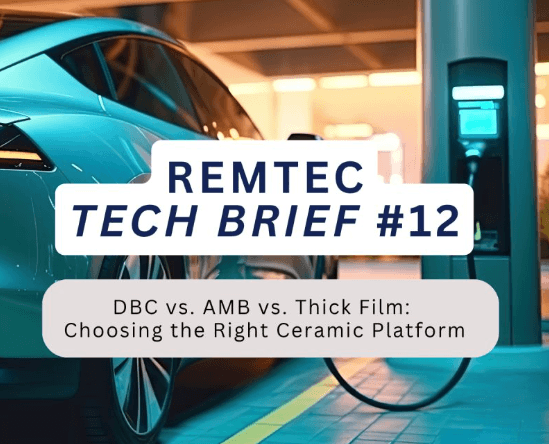
Practical Guidance for Power, Reliability, and Precision Electronics

Selecting the right ceramic substrate can have a major impact on system performance, reliability, and overall product cost. The wrong choice may create thermal limitations, reduce operational life, or add unnecessary manufacturing complexity. The right choice helps optimize power handling, heat management, and long-term durability.
At Remtec, we help engineers and OEMs evaluate ceramic technologies every day. While every application has unique requirements, understanding the strengths of Direct Bonded Copper (DBC), Active Metal Brazed (AMB), and Thick Film (TF) substrates is the first step toward making the right decision.
Direct Bonded Copper (DBC): Industry Workhorse for Power Electronics
DBC technology bonds thick copper directly to a ceramic substrate, creating an ideal platform for medium-to high-power electronic applications that require good thermal management, high current-carrying capacity while maintaining electrical isolation with proven reliability. Common applications include:
- Electric Vehicle traction, on-board charging, DC-DC converters, and battery management systems
- High-Power Power Supplies for data center and uninterrupted power supplies and industrial converters
- Industrial Motor Drives for servo and variable-frequency, robotic and factory automation systems
- Renewable Energy solar inverters, wind turbine converters, and energy storage systems
- High-Power LED Lighting for stadium and industrial lighting, automotive headlights, UV curing
Why Engineers Choose DBC: DBC has become the industry benchmark for power electronics because it delivers an excellent combination of thermal performance, current-carrying capability, and proven field reliability.
Best fit when: Power levels are moderate to very high, the environment is not extremely mechanically demanding but costs and manufacturing are important along with long-term field reliability requirements and a mature supply chain is preferred.
Active Metal Brazed (AMB): Built for High-Power, High-Reliability Power Electronics
AMB technology creates a highly reliable copper-to-ceramic bond that is best suited for high-power, high-reliability power electronics where both thermal performance and mechanical durability are critical. Common applications include:
- Electric Vehicle traction and onboard chargers using SiC or IGBT power modules
- Industrial Motor Drives that experience frequent thermal cycling
- Renewal Energy converters and power inverters
- Railway and Transportation traction and high-voltage DC transmission equipment
- Aerospace and vibration-intensive environments where substrate toughness is important
Why Engineers Choose AMB: Compared to many other substrate options, AMB offers high fractural toughness and mechanical strength providing excellent resistance to thermal cycling, good thermal conductivity and heat spreading. With AMB’s strong copper-to-ceramic bond supports compatibility with thick copper layers for high-current designs.
Best fit when: When reliability under repeated temperature swings matters more than achieving the absolute highest thermal conductivity. For applications focused solely on maximum heat removal, AMB aluminum nitride (AlN) may be considered, but silicon nitride (Si₃N₄) is usually favored for automotive and long-life power modules because of its superior toughness and cycling endurance.

Thick Film (TF) Ceramic: Precision, Integration, and Design Flexibility
Unlike copper-clad ceramic technologies, Thick Film substrates allow conductive, resistive, and dielectric materials to be printed directly onto ceramic, enabling highly customized circuit designs. Common applications include:
- RF and Microwave Modules for communication, radar electronics, and wireless sensors
- Medical Electronic sensors, diagnostic instruments, and implantable devices
- Industrial Sensors and process control instrumentation
- Aerospace and Defense Electronics for avionics and guidance, and harsh-environment systems
- Hybrid Microelectronics for analog signal conditioning, power controls, and mixed-signal electronics
Why Engineers Choose Thick Film: Thick Film technology enables compact layouts, integrated passive components, and highly customized designs. It’s ideal for applications where precision, miniaturization, and circuit integration are more important than maximum current capacity.

Best fit when: the need is for low- to medium-power electronic circuits that need excellent environmental stability, compact size, and the ability to integrate passive components directly onto the substrate.
Quick Comparison
| Requirement | DBC | AMB | Thick Film |
| High Current Capability | Excellent | Excellent | Moderate |
| Thermal Performance | Excellent | Excellent | Good |
| Thermal Cycling Reliability | Very Good | Excellent | Good |
| Precision Circuit Features | Moderate | Moderate | Excellent |
| Integrated Passive Components | Limited | Limited | Excellent |
| Harsh Environment Performance | Very Good | Excellent | Good |
| Design Flexibility | Moderate | Moderate | Excellent |
When One Technology Isn’t Enough
Many advanced electronic systems benefit from combining multiple ceramic technologies within a single package or assembly, for example:
- DBC may be used for high-power switching stages.
- Thick Film can support control, sensing, or signal conditioning functions.
- Custom packaging integrates both technologies into a single optimized solution.
This hybrid approach allows designers to balance power handling, thermal management, precision circuitry, and system integration.
The Right Choice Starts with the Application
Choosing a ceramic platform isn’t simply about selecting a material or process; it requires understanding the real-world operating environment, including:
- Power and current requirements
- Thermal loads
- Environmental conditions
- Reliability expectations
- Product lifecycle goals
The most successful designs align substrate technology with actual application demands from the beginning of the development process.
Evaluating ceramic substrates for your next design? Let’s start the conversation.
At Remtec, we work closely with OEMs and engineering teams to evaluate these factors early, helping reduce design risk, improve reliability, and accelerate time to market. Whether your challenge is maximizing power density, improving thermal reliability, or integrating precision circuitry, the best ceramic solution starts with understanding your application requirements. Learn more or schedule a free, virtual lunch & learn by reaching out via our Contact page.