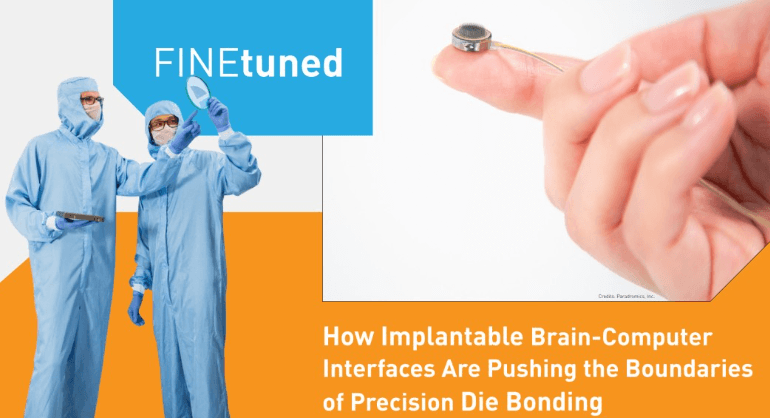
A patient who can no longer speak generates text directly from neural activity. A patient with paralysis controls a cursor using thought alone.
Behind demonstrations like these is a difficult engineering problem: how do you assemble electronics delicate enough to interact with the human brain, while keeping them stable inside the body for years?
Implantable Brain-computer interfaces (BCIs) are moving steadily from research labs toward real medical applications. Companies such as Neuralink, Paradromics, Synchron, and China-based Neuracle are developing implantable systems designed to connect electronics directly with the nervous system.
BCIs are a good example of an application where Finetech’s technological capabilities can make a difference. Bringing together miniaturized electronics, delicate substrates, and fine interconnect structures requires highly precise, controlled, and adaptable assembly processes, especially as these systems move from research toward practical medical use.
One early example was the CANDO project, a joint research initiative of the University of Newcastle developing optogenetic brain implants for epilepsy treatment, assembling µLED components below 100 µm onto optrode substrates, with 0.5-micron placement accuracy and custom tooling for biocompatible soldering. The experience made clear early on what this application domain requires: not just precision, but the ability to adapt processes across a development cycle where materials, geometries, and bonding methods change continuously.
Today, we see researchers working on systems that could:
- restore communication for patients who can no longer speak
- help paralysis patients interact with digital devices
- improve control of advanced prosthetics
- support treatment of neurological conditions such as epilepsy or Parkinson’s disease
Even relatively simple digital interaction can make a meaningful difference for people who have lost the ability to communicate or move independently.
As the technology progresses, the challenge is no longer only to interpret neural signals more accurately. Implant systems must also withstand long-term use inside the body, creating growing demand for precise, stable, and adaptable bonding processes.

The Human Body and Microelectronics Are Difficult to Combine
Neural implants bring together two things that are not naturally easy to combine: highly sensitive microelectronics and the mechanical, chemical, and thermal conditions inside the human body.
Inside the body, implants are continuously exposed to moisture, corrosion, immune responses, mechanical stress, and micromovements.
At the same time, implants are becoming smaller, denser, and more thermally sensitive. Flexible electrode structures can better match human tissue and reduce stress around the implant site, but they are also harder to assemble. Handling delicate substrates and maintaining precise alignment across sensitive material combinations places additional demands on die bonding accuracy and process stability.
BCIs Are Becoming a Precision Assembly Challenge
Modern neural implants combine technologies such as:

- CMOS chips
- MEMS structures
- flexible electrode arrays
- sensors
- thin-film substrates
- biocompatible materials
Many current developments aim for thousands of recording channels packed into extremely compact implant areas with increasingly fine interconnect structures.
Even small deviations can affect signal quality, interconnect stability, electrical performance, and long-term reliability. Sub-micron die placement can become particularly important when integrating high-density chips with delicate electrode arrays or flexible substrates.
Compared to conventional electronics assembly, BCIs place particularly high demands on force control, thermal management, process repeatability, and the stable handling of fragile components.
Depending on the device architecture, processes such as thermocompression, ultrasonic, adhesive, or laser-assisted bonding can each offer specific advantages.

From Lab Demonstrator to Manufacturable Device
Many BCI concepts already work in laboratory environments. Turning them into reproducible medical devices is considerably harder. Neural interface designs evolve quickly, material combinations change, and assembly processes must often be adapted during development.
Moving from feasibility studies toward scalable manufacturing requires repeatable alignment accuracy, stable bonding behavior, flexible process development, and controlled process environments. Better neural decoding alone will not be enough if implants cannot be assembled reliably and withstand long-term use inside the body.
Building a stable connection between electronics and the human nervous system is not only a neuroscience challenge. As BCIs move closer to practical medical use, precision die bonding is becoming part of the foundation that makes these systems possible.
Finetech is currently developing the next generation of production die bonders. Click here for the latest updates on the upcoming high-mix volume die bonding platform FiNEXT P3.
Stay connected between editions. Follow us on LinkedIn for regular updates on die bonding innovation, and visit finetech.de to discover how we support innovators worldwide from prototype to series production.