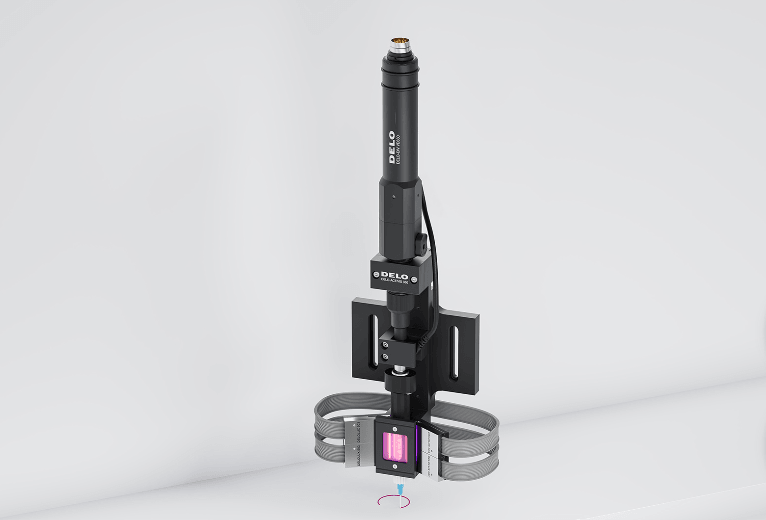
Next level production processes: Dispensing and activation in one step — compact, smart, seamless.
The new DELO-ACTIVIS 330 is significantly smaller than its predecessor, the DELO-ACTIVIS 600, which greatly simplifies integration into existing production lines. Specially designed for the precise processing of even the smallest amounts of adhesive from 4 µl, DELO is responding directly to customer demand for system solutions with smaller dimensions and finer dosages.
Significantly smaller
The new all-in-one system solution from DELO
With a height of approximately 387 mm, the new model DELO-ACTIVIS 330 is around 80 mm smaller and thus significantly more compact than the DELO-ACTIVIS 600.
This simplifies integration into existing production lines. The core of the system is the patented activation on the flow (AOF), which combines the necessary steps of dispensing and curing in a single step. The adhesive is preactivated during dispensing by means of an integrated light source in the device. Curing begins before the adhesive reaches the component.
Advantages of the new model
- Maximum design freedom: Suitable for complex geometries and opaque materials allows complete freedom in product design
- Higher product quality: The use of adhesives allows for lighter constructions, smooth surfaces, and compensates for tolerances
- Reduced process costs: Direct further processing through simultaneous exposure and dosing
- Sustainable: Reduces CO₂ emissions (by up to 98%) and energy consumption
- Easy integration: Space-saving and can be used as a standalone system
- High media and temperature resistance: Flexible adhesive options for various requirements
Expanded AOF adhesive portfolio
The right material for every design
Parallel to the market launch of DELO-ACTIVIS 330, DELO is expanding its range of high-tech adhesives specially developed for activation on the flow (AOF) from three to eight. The expansion of adhesives is just as crucial as the development of DELO-ACTIVIS 330. This is because the new adhesives allow a new level of freedom in component design, thus opening up further application possibilities.
The expanded portfolio covers a wide range of adhesive properties:
- From low viscosity (ideal for fine structures and display applications such as MiniLED/MicroLED) to high viscosity
- From transparent to black
- From soft-elastic to high-strength
At the same time, all new adhesives are optimally designed for fast, space-saving, and climate-friendly production processes.

Viscosity
Viscosity describes the thickness of an adhesive, i.e. its internal resistance to flow. It is a measure of how easily the material can be dispensed, spread, and positioned on the component. Viscosity is caused by the internal friction of the particles.
- Low-viscosity adhesives are thin (e.g. water). They are suitable for fine structures, narrow gaps, and capillary effects (e.g., MiniLED/MicroLED). Due to their high flowability, low-viscosity adhesives spread completely, resulting in uniform curing and very good adhesion.
- High-viscosity adhesives (e.g. honey) are shape-stable. They are used when the adhesive must not run or must fill gaps (e.g. on uneven surfaces or vertical geometries). Their viscous consistency prevents overflowing and allows for controlled dispensing.
The viscosity of adhesives is temperature-dependent—it decreases as the temperature rises. The unit of measurement for viscosity is mPa·s (millipascal seconds).
Adhesives instead of compromises
Modern product requirements demand solutions that combine functional stability, aesthetics, and efficient manufacturing. Conventional methods (screws, rivets) quickly reach their limits here. They often leave visible marks and lead to mechanical stresses, especially in lightweight or transparent materials.
Modern adhesive technologies such as DELO-ACTIVIS 330 offer decisive advantages here. They enable different materials to be securely bonded without visible fasteners and with minimal restrictions on design.
The combination of technical performance, design freedom, and process reliability is becoming the basis for many new design concepts.