Toray Industries, Inc., announced today that Ministry of Land, Infrastructure, Transport and Tourism has designated the company’s on-site vacuum-assisted resin transfer molding (VaRTM; note 1) repair and reinforcement technique for carbon fiber-reinforced plastic (CFRP) as a fiscal 2026 Technology for Promoted Utilization (note 2). The technique employs Toray’s vacuum infusion molding technique, which is registered in the ministry’s New Technology Information System (NETIS; note 3) database.
Each year, the Ministry selects technologies from the NETIS database that demonstrate outstanding effectiveness and are considered beneficial for nationwide adoption. Toray’s on-site VaRTM technique was recognized for its usefulness in the maintenance and management of social infrastructure. In addition, as projects utilizing designated technologies are eligible for additional points in construction performance evaluations, the selection is expected to further promote the adoption of the technology.
Japan faces growing challenges in maintaining and extending the service life of bridges, transmission towers, port and marine facilities, and other social infrastructure developed during its period of rapid economic growth. For steel structures, repair and reinforcement have traditionally been performed by bolting or welding steel cover plates to the base material. However, these methods involve handling heavy materials and hot work, while also presenting challenges such as thermal effects and potential damage to the structure, as well as difficulties in adapting to complex geometries. These challenges are driving demand for repair and reinforcement technologies that can be applied safely in environments where the use of ignition sources is restricted, such as explosion-hazard areas, while providing enhanced safety, construction efficiency, and consistent quality.
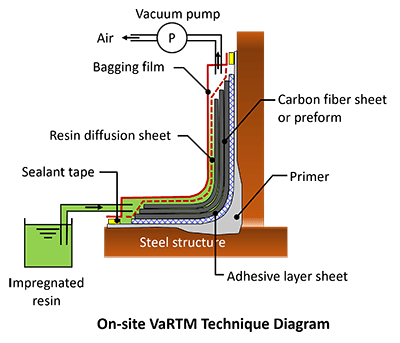
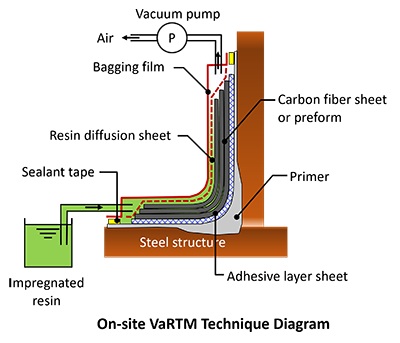
Toray’s technology applies conventional VaRTM technique, widely used for manufacturing structures using fiber reinforced plastics such as aircraft components, wind turbine blades, and automobiles, to the repair and reinforcement of steel structures using CFRP. For deteriorated steel structures affected by corrosion or section loss, multiple layers of carbon fiber sheets, together with resin injection and vacuum tubes, are placed on the repair area and covered with a sealing film. After establishing a vacuum, resin is injected, impregnated, and cured in a single process through atmospheric pressure and vacuum-pump suction, thereby forming a CFRP reinforcement directly on-site.
The technology forms highly conformable CFRP reinforcement without internal voids. It also offers excellent workability by preventing resin scattering and minimizing the impact of weather variations during curing. Since no welding or other hot work is required, the technology can be used in environments where ignition sources are restricted, such as explosion-hazard areas. In addition, the lightweight and corrosion-resistant properties of carbon fiber improve the handling and transportation of materials and equipment, helping to shorten construction periods, reduce project costs, and enhance long-term durability.
Leveraging its selection as a fiscal 2026 Technology for Promoted Utilization by the Ministry, Toray will further expand the application of the technology in steel-structure fields requiring corrosion mitigation and structural reinforcement, including road infrastructure, transmission towers, ships, and offshore structures.
Through collaboration with construction companies, infrastructure owners, and other relevant stakeholders, Toray aims to contribute to extending the service life of social infrastructure and advancing infrastructure maintenance and asset management both in Japan and around the world.

Toray will continue to promote the development of high-value-added products utilizing its advanced materials technologies, guided by its corporate philosophy of “contributing to society through the creation of new value with innovative ideas, technologies and products.”
Notes
- The on-site VaRTM technique entails placing Toray’s TORAYCA™ carbon fiber sheet on the surface of a steel structure requiring repair, covering with a sealing film, and subjected to vacuum pressure. Epoxy resin is then injected and cured, integrating the CFRP reinforcement with the steel structure. Unlike conventional carbon-fiber sheet bonding methods, which require each layer to be individually impregnated with resin and applied one at a time, the on-site VaRTM method enables simultaneous installation of multiple layers. The method also eliminates the need for welding or other hot work, making it suitable for repairs in explosion-hazard and other restricted environments.
- The Ministry of Land, Infrastructure, Transport and Tourism published its list of eight fiscal 2026 Technology for Promoted Utilization on July 14, 2026
- NETIS is a database operated by the Ministry of Land, Infrastructure, Transport and Tourism of Japan for sharing and providing information on innovative technologies. The system consists of application information and evaluation information and is operated primarily based on the latter. Evaluation information is classified into technologies not subject to continued monitoring following post-evaluation and technologies designated for continued monitoring.
Related News Releases
- September 13, 2024 – Toray Obtains Type Approval from American Bureau of Shipping for In-Situ Repair Technique Employing Carbon Fiber Composites
- December 18, 2023 – MODEC and Toray Jointly Develop FPSO and FSO Repair Technique Using CFRP Patch: ABS Certification for Repair Method for Localized Damaged Parts Due to Corrosion
- January 23, 2023 – Toray Becomes Joint Winner in Japan’s Sixth Infrastructure Maintenance Awards for Developing Innovative Technique to Repair Transmission Tower Corrosion
- December 24, 2020 – Toray Develops FPSO and FSO Repair and Reinforcement Technique with MODEC